Monash Neurointervention
Designing and advancing the future of neurovascular care through clinical excellence, patient-centred care, and innovative research to reduce disability and extend life.
Rupture Risk in Small Unruptured Intracranial Aneurysms
Systematic Review and Meta-Analysis
WHAT THIS STUDY DOES
This study examines how often small unruptured intracranial aneurysms rupture when they are managed without treatment.
It brings together data from multiple global studies to provide a clear, evidence-based estimate of rupture risk.
WHY THIS MATTERS
When an aneurysm is found, a key question is:
“What is the risk if we do not treat it?”
Clinical decisions often rely on simplified assumptions about rupture risk.
This study provides a more precise estimate based on observed follow-up data.
WHAT WE FOUND
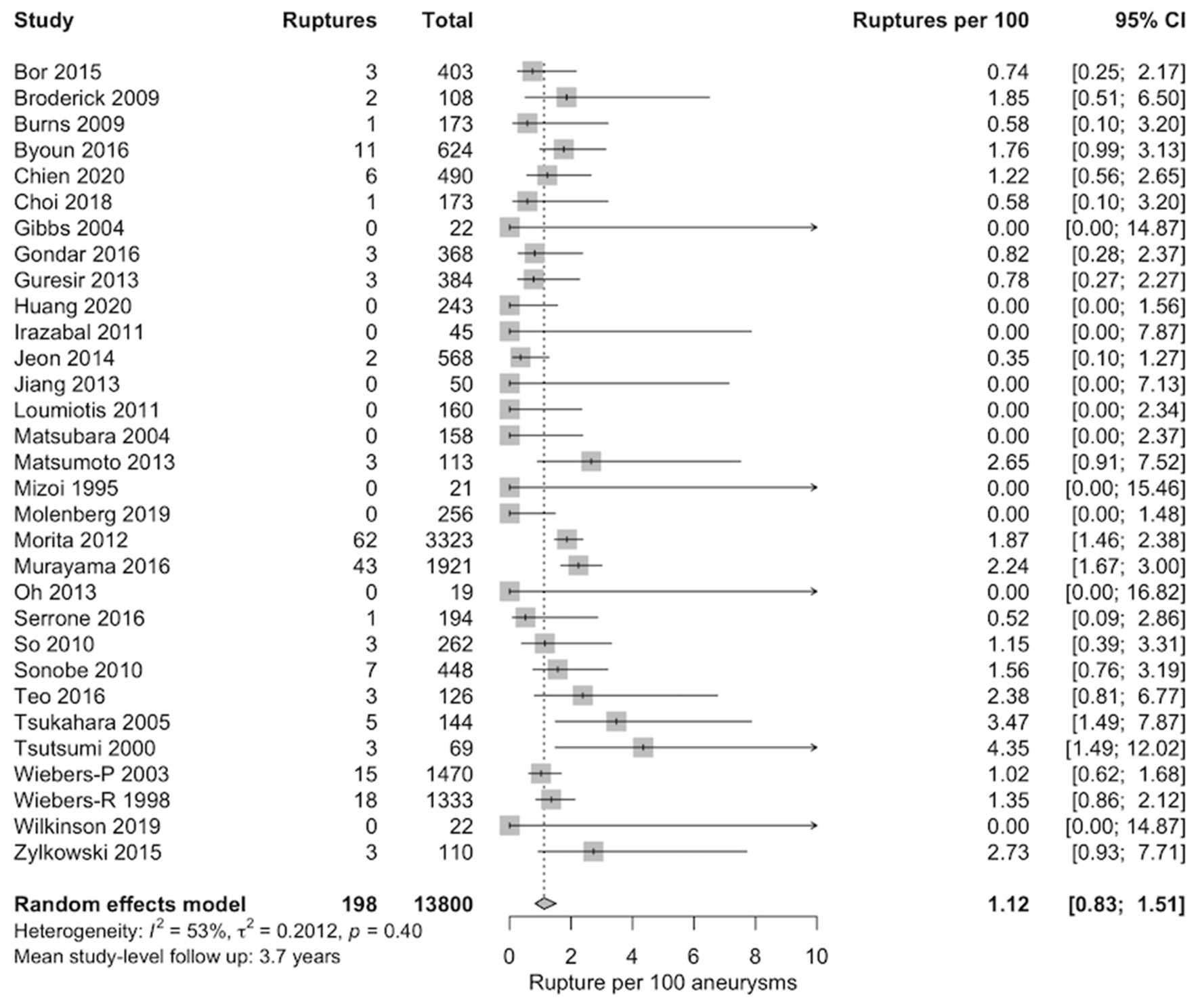
- 31 studies, ~13,800 aneurysms
- Mean follow-up ~3.7 years
Rupture risk
- For every 100 aneurysms ≤10 mm managed conservatively, approximately 1 will rupture over ~4 years (range ~0.8–1.5%)
Additional insights
- Results are most applicable to 2–5 mm aneurysms, which made up the majority of included cohorts
- Estimates reflect observed follow-up (~3–4 years), not lifetime extrapolation
- Overall rupture risk is low, but not zero
Study quality matters
- Higher-quality studies: ~1.8% over ~3.9 years
- This suggests rupture risk may be underestimated in lower-quality studies
Important context
- Results reflect patients selected for conservative management
- Risk estimates depend on study quality and follow-up duration
These findings provide a practical, evidence-based way to communicate rupture risk over the time period for which data are available.
📈 KEY FIGURE
HOW THIS STUDY WAS DONE
- Systematic review (PROSPERO registered)
- 4 major databases searched
- Random-effects meta-analysis
- Heterogeneity assessed (I²)
- Meta-regression performed
- Sensitivity analyses across size thresholds
Full methods are available in the paper and supplementary materials
WHY THE RESULTS ARE ROBUST
This study includes:
- Large pooled dataset
- Formal heterogeneity assessment
- Outlier and influence analysis
- Multiple sensitivity analyses
Results remained consistent across analyses
REPRODUCIBILITY
All data extraction and analysis steps are available in this repository.
To reproduce the analysis:
- Load dataset
- Run meta-analysis script
- Generate figures
REPOSITORY CONTENTS
- Extracted study-level dataset
- Analysis scripts (R)
- Figures and outputs
- Supplementary material
REFERENCE
Chandra RV, Maingard J, Slater L-A, Cheung NK, Lai LT, Gall SL, Thrift AG and Phan TG (2022) A Meta-Analysis of Rupture Risk for Intracranial Aneurysms 10 mm or Less in Size Selected for Conservative Management Without Repair.
Frontiers in Neurology.
https://doi.org/10.3389/fneur.2021.743023